
Thom Browne Inc & Anor v adidas AC & Ors [2024] EWHC 2990 (Ch)
Key takeaways
- Clarity is king: For position marks, the combination of image and description must be crystal clear and precise. Vague or overly broad depictions will not survive scrutiny.
- Post-sale confusionis hard to prove: Without strong visual similarity or a shared consumer perception, this type of claim remains difficult terrain for brand owners.
- Procedural rigour matters: Even in complex IP litigation, failure to follow evidential rules can attract judicial criticism and undermine credibility.
Introduction
High Court finds Thom Browne’s “four bar” design does not infringe adidas’ three stripe position marks
In a decision with wide-ranging implications for position marks, the High Court dismissed adidas’ claims that Thom Browne’s ‘four-stripe’ motif infringes its iconic three-stripe logo. The ruling, handed down by Mrs Justice Joanna Smith in Thom Browne Inc v adidas AG [2024] EWHC 2990 (Ch), scrutinised the validity and enforceability of adidas’ position marks in detail.
The Judge’s analysis covered a gargantuan 775 paragraphs, 16 position mark registrations, and 24 specimen Thom Browne products. Despite the abnormal length of the decision, adidas limped away with only eight surviving marks, and no finding of infringement.
The law
Section 3(1) of the Trade Marks Act 1994 provides (so far as is relevant):
3 Absolute grounds for refusal of registration.
(1) The following shall not be registered—
(a) signs which do not satisfy the requirements of section 1(1),
(b) trade marks which are devoid of distinctive character…
The relevant case law in relation to position marks is principally set out in Nestlé v Cadbury[1]. Applying Nestlé v Cadbury to underlying CJEU case law, the Judge set out the following guiding principles[2]:
- The graphical representation must enable the sign to be represented visually, particularly by means of images, lines or characters, so that it is clear and can be identified precisely.
- The graphical representation “encompasses both the visual representation and any verbal description” and must be considered as a whole. Neither the visual representation, nor the description, takes precedence.
- The verbal description of the sign “must serve to clarify the subject matter and scope of the protection sought under trade mark law and such a description cannot be inconsistent with the graphic representation of a trade mark or give rise to doubts as to the subject matter and scope of that graphic representation”.
- The underlying rationale for the requirements for registration is twofold: (i) first, they are necessary for the proper working of the trade mark registration system, both from the point of view of the competent authority who must examine the mark for registration and from the point of view of economic operators who need to know what they can and cannot do; and (ii) second, they are necessary so that the trade mark can serve its function as an indication of origin.
- “…the function of the graphic representation is, in particular, to define the sign so that the subject matter for which protection is sought or has been secured can be clearly and precisely identified by the competent authorities and the public. Moreover and importantly, in order to fulfil its role as a trade mark and meet the requirements of precision and clarity, the sign must always be perceived unambiguously and uniformly….it follows that if the authorities and the public are left in a state of confusion as to the nature of the sign then these requirements will not be satisfied”[3].
The Adidas position marks
Thom Browne brought a claim against Adidas for invalidity of sixteen position marks. Adidas counterclaimed for trade mark infringement and passing off.
The adidas marks were filed as combinations of visual stripes and accompanying descriptions, placed on a variety of garments, bags and footwear. A representative selection of the adidas position marks is shown in the table below.
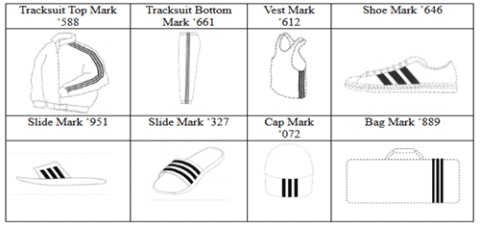
By way of further example, the Tracksuit Top Mark was registered with the accompanying description
The mark consists of three equally spaced stripes, all of the same colour, applied to the exterior of the goods covered by the specification, the stripes running down substantially the whole length of the outer lateral surface of the sleeves, legs and/or trunks of the goods, the stripes contrasting with the colour of that part of the goods to which the stripes are applied, as illustrated on the form of application.
The first instance decision[4]
The court considered the validity of the position marks. In doing so, it took account of the stringent requirements and governing principles laid out by UK and EU statute and case law, particularly as the need for clarity and precision[5].
The Judge assessed each mark in turn, finding that eight of them failed to satisfy these standards. The Judge noted several inconsistencies in the graphical representations, as well as ambiguities in the verbal descriptions, including the Tracksuit Top Mark, which the Judge found to be
insufficiently clear, intelligible, precise, specific and accessible to be capable of registration…involv[ing] a multiplicity of signs which extend beyond any permissible degree of variation[6].
The court applied similar reasoning in finding seven other marks were invalidly registered.
In relation to the remaining adidas position marks, the Judge ordered a partial revocation for some of the marks due to non-use.
The counterclaim on infringement
Adidas’ counterclaim for infringement was brought under sections 10(2) and 10(3) of the Trade Marks Act 1994 in relation to Thom Browne’s four-stripe design, as applied to 24 product lines, including on jackets, trousers, bags and socks. A selection of the Thom Browne product styles is shown below.


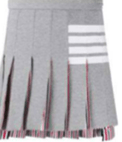
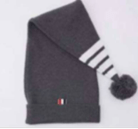
Addressing similarity of the ‘marks’, the Judge concluded that only some of the Thom Browne products bore a moderate similarity to the adidas position marks, with most deemed only “faintly” similar. The remaining few, such as the bobble hat, were found not similar. In determining similarity, the court took account of the decisive nature played by the position of the respective three-stipe mark, as well as the ability of the “average consumer…to perceive differences between the appearance of stripes, their width and the distance between them (i.e. their pattern)”[7].
The case for infringement
Adidas’ claimed that under section 10(2) there was post-sale confusion. This is slightly unusual as a typical claim will focus on confusion at or prior to the sale.
Post-sale confusion is often employed by premium fashion brands, as it removes the impact of price and differing sales channels, with a focus on what the average consumer sees when the product in use. Post-sale confusion can arise even where there is no likelihood of confusion at the point of sale. It does not however give rise to a different assessment with a different form of hypothetical consumer having a different attention span, nor does it reflect the occasional situation in which the product may be obscured or difficult to see.
The Judge concluded that the Thom Browne products did not lead to a likelihood of confusion – a decision that was supported by the lack of any actual confusion either during or post sale[8]. The court also considered indirect confusion, but it was not convinced that the average consumer would perceive or be likely to perceive a collaboration between the parties.
The lack of similarity between the position marks and the Thom Browne products also led to adidas failing in its claim under section 10(3) for unfair advantage, with the Court determining a lack of any link arising between the marks. Adidas’s claim in passing off also failed.
Over-lawyering and Procedural Criticism
As an aside, the judgment also criticised the conduct of adidas’ solicitors in preparing witness evidence, which the Judge held incompatible with – the relatively new – Practice Direction 57AC. It was described as a “whole new level” of non-compliance. In respect of adidas’ witness statements, the Judge said “regrettably, they were heavily over-lawyered” that blurred the line between narrative and advocacy. Despite acknowledging the inherent difficulty in presenting evidence of long-term brand use, the Court was clear that procedural rules must be respected.
References
[1] Société Des Produits Nestlé S.A. v Cadbury UK Limited [2013] EWCA Civ 1174, [2014] RPC 7
[2] Paragraph 122
[3] Glaxo Wellcome UK Ltd v Sandoz Ltd [2017] EWCA Civ 335
[4] Thom Browne Inc & Anor v adidas AC & Ors [2024] EWHC 2990 (Ch)
[5] Paragraphs 112 to 139
[6] Paragraph 174
[7] Paragraph 447
[8] Paragraph 611