
No ‘Hand of God’ for High Court referrals
Trade mark appeals – section 76(3) Trade Marks Act 1994 – appellate procedure – High Court referral – when Appointed Person should exercise discretion – what is a point of “general legal importance”, impact of failure to plead case fully under Civil Procedure Rules, Part 16.5(2)
Summary
In Podium Icons Limited (formerly Maradona Global Limited) v Diego Armando Maradona Sinagra & Others (BL O/0743/25), the Appointed Person, Dr. Brian Whitehead, refused an application to transfer an appeal to the High Court under section 76(3) of the Trade Marks Act 1994.
The underlying appeal is in respect of the decision of a Hearing Officer at the UK IPO dated 15 May 2025 which held that the consolidated oppositions brought by Diego Armando Maradona Sinagra & Others (Opponent / Respondent), to the Appellant’s applications were successful.
This ruling provides helpful insight as to when discretion should be exercised in permitting transfers from the Appointed Person to the High Court. It also acts as a reminder of how crucial it is for applicants to include a substantial defence in their TM8 and counterstatements.
Background
Podium Icons Limited (formerly Maradona Global Limited) (Applicant / Appellant) sought to register three UK trade marks across a wide range of goods and services for:
- UK trade mark application no. 3828657

- UK trade mark application no. 3829141 DIEGO ARMANDO MARADONA
- UK trade mark application no. 3829134 DIEGO MARADONA
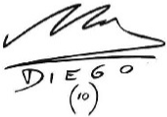
(the Applications)
The Applications were opposed and the Hearing Officer upheld each opposition, concluding that the Applications should be refused. The Applicant subsequently appealed to the Appointed Person before later requesting that the appeal be transferred to the High Court. No reasons for the requested transfer were provided.
The law
Appeals from decisions of the Registrar may be brought either to the High Court or to an Appointed Person under section 76(2) of the Trade Marks Act 1994. Where an appeal is brought before an Appointed Person, section 76(3) provides for discretion to refer the appeal to the High Court if:
- a point of general legal importance is involved;
- the Registrar requests that it be so referred; or
- such a request is made by any party to the proceedings before the Registrar in which the decision appealed against was made.
The principles applicable to a decision to transfer have been considered several times by the Appointed Person. In Parkair Trade Mark O/065/09, Amanda Michaels acting as the Appointed Person reviewed earlier decisions including A.J. AND M.A. LEVY’s trade mark (No. 2) [1999] R.P.C. 358, Academy trade mark [2000] R.P.C. 35, Royal Enfield trade mark O/273/01, EBC trade mark O/132/03, and Elizabeth Emanuel Trade Mark [2004] RPC 15 and summarised the applicable principles as follows:
- the Appointed Person has an unfettered discretion under section 76(3);
- any consensus reached between the parties about referring the appeal to the court is not determinative;
- the power to refer appeals to the court should be used sparingly, otherwise the clear object of the legislation to provide a relatively inexpensive, quick and final resolution of appeals by a specialist tribunal would be defeated;
- it will be rare for a referral in circumstances where no point of general legal importance can be identified;
- the cost and expense to the party not seeking to refer should be taken into account;
- regard must be had to the public interest generally. There is a public interest in having any uncertainty as to the state of the register resolved as soon as possible. On the other hand, there is a public interest in having important points of law decided by the higher courts;
- the attitude of the Registrar is important but not decisive;
These principles confirm that referrals will only be appropriate where the criteria above justify departing from the Appointed Person route.
Was there a point of general legal importance?
The decisive consideration was whether the appeal raised any point of general legal importance which justified the Appointed Person exercising his discretion under section 76(3)(a).
The Appointed Person having reviewed the grounds of appeal in the Appellant’s Form TM55 determined that no point of general legal importance was raised.
The absence of any cogent defence or evidence
Whilst the Appointed Person determined that the issues of law raised in this appeal are straightforward and have no wider impact on the public more generally, they took this opportunity to address the conduct of the Appellant in the underlying opposition proceedings.
It was reiterated that the Hearing Officer had noted that the Applicant filed no evidence. Additionally, the defences merely denied the allegations with each consisting of a brief sentence without explaining why they were disputed or setting out any positive case. In particular, the Applicant asserted that it was “the legitimate owner” of the trade mark rights without identifying any factual or legal basis for that assertion. Furthermore, the Applicant’s defence incorrectly contained denials of specifications being similar where the respective specifications covered identical terms.
The Appointed Person noted that the UKIPO Trade Marks Manual explains that:
the purpose of the counterstatement is to admit, deny with explanation or indicate that proof is required of any of the grounds set out by the opponent in its statement of grounds.
Whilst the Trade Marks Manual has no force in law, this is in accordance with the Civil Procedure Rules, Part 16.5(2).
The consequence was that by failing to provide a substantive defence to any of the Respondents’ assertions, the Appellant was (at best) putting the Respondents to proof on their oppositions.
As the Appointed Person noted, this left the Hearing Officer with a relatively straightforward task: determining whether the Respondents put forward sufficient arguments and evidence to make good their oppositions through evidence and submissions. Likewise, the appeal itself was limited to assessing whether the Hearing Officer had erred in principle or reached a decision that was wrong.
Whilst these comments were made in the context of deciding the transfer application, the additional commentary makes for useful guidance for practitioners preparing TM8 counterstatements. Unsubstantiated denials are unlikely to assist either the Hearing Officer or a client.
Conclusion
Having considered all the relevant factors above, the Appointed Person concluded that there was no justification for transferring the appeal. The Appellant’s application to transfer the appeal to the High Court was therefore dismissed, with the appeal remaining before the Appointed Person.
Key points
This decision provides valuable guidance on the procedural framework under which the Appointed Person will exercise their discretion to refer a matter to the High Court.
It is a useful reminder that parties should not assume that a request under section 76(3) will be granted automatically merely because the dispute is commercially significant or high profile. Instead, applicants seeking a transfer should be prepared to identify a genuine point of wider legal importance.
The Appointed Person’s discretion to refer appeals remains unfettered but should be exercised sparingly. Otherwise, the legislation’s fundamental goal of allowing a specialised independent tribunal to decide appeals in a timely, cost-effective, and definitive manner would be lost.
Equally, the decision serves as a helpful reminder that properly argued TM8 counterstatements remain fundamental to opposition proceedings and should not be seen as a tick-box exercise. Empty denials may leave applicants with little scope to challenge an adverse decision on appeal, particularly where no substantive factual or legal defence is advanced.
Link to decision results: https://www.ipo.gov.uk/t-challenge-decision-results/o074325.pdf