Lidl & another v Tesco & another [2024] EWCA Civ 262
https://www.judiciary.uk/wp-content/uploads/2024/03/Lidl-v-Tesco-CoA-Judgment-19.03.24.pdf
Key points
- Trade marks are not be used as “legal weapons” to secure a broader monopoly than is intended to be used.
- Tesco infringed Lidl’s trade marks and misrepresented that its prices were equivalent to Lidl’s. Tesco did not infringe Tesco’s copyright in Lidl’s yellow circle.
- Lidl acted in bad faith when it sought to register the yellow circle as a trade mark and it was invalid as a consequence.
In the latest instalment of the clash between supermarket giants Lidl and Tesco, the English Court of Appeal has issued judgment affirming the High Court’s findings of trade mark infringement and passing off, while overturning the ruling on copyright infringement. The Court provided valuable clarification on key issues of consumer perception, evidential thresholds, and bad faith registration — all of which have wide-ranging implications for brand owners and marketing practices in the retail sector and beyond.
Background
The dispute centres on Tesco’s use of a yellow circle on a blue background for its “Clubcard Prices” promotion, which Lidl claimed infringed its long-established logo. Lidl owns several trade mark registrations, including for the word “LIDL” in red within a yellow circle and a wordless version of the same mark — the so-called “Wordless Mark”.
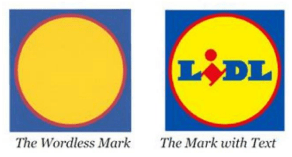
Lidl brought claims for trade mark infringement under sections 10(2) (likelihood of confusion) and 10(3) (unfair advantage of reputation) of the Trade Marks Act 1994, passing off, and copyright infringement. Tesco counterclaimed for a declaration of invalidity of the Wordless Mark, arguing it was filed in bad faith or alternatively that it had not been put to genuine use.
Examples of Tesco’s use are shown below:

The first instance decision[1]
The High Court found that:
- Tesco had infringed under section 10(2) and 10(3) and passed off;
- the Wordless Mark was invalid because it was filed in bad faith; and
- Lidl was entitled to an injunction for copyright infringement.
All points were appealed – you can read more about that decision in this article.
The law relating to appeals
An appeal court can only intervene with a decision based on a finding of fact where the lower court’s findings are rationally insupportable[2]. Where the decision involves multi-factorial evaluations by the judge, the Court of Appeal is only entitled to intervene if the judge erred in law or principle[3].
The Court of Appeal was formed from three judges in this case, as usual. Lord Justice Arnold gave the leading judgment. Lord Justice Birss and Lord Justice Lewison also gave their judgments. The Lords’ views differed slightly but reached the same conclusion overall.
The appeal on passing off
Tesco’s appeal was dismissed. The first instance judge was entitled to find that a substantial number of consumers would be misled by Tesco’s signs into thinking that Tesco’s Clubcard Prices were the same or lower than Lidl’s for equivalent goods. Despite Tesco’s arguments on appeal, the evidence the trial judge had relied upon was admissible, relevant and probative. The earlier decision was rationally supportable.
The appeal on trade mark infringement
The Court of Appeal upheld the High Court’s finding that Tesco’s signage infringed Lidl’s trade marks and found:
…the trade mark claim and the passing off claim very difficult, at the outer boundaries of trade mark protection and passing off.
Tesco’s argument on appeal was that the judge was wrong to find that there had been a change in economic behaviour of consumers (and therefore the necessary damage to establish trade mark infringement). However, this finding was based on the evidence which the judge was entitled to do so. The decision was therefore rationally supportable.
What does “without due cause” actually mean?
Although it did not affect the outcome, the positions of the appeal judges Arnold LJ, Birss LJ and Lewison LJ differed slightly on the question of when infringing activity would be justified for “due cause”.
Section 10(3) of the Trade Marks Act 1994 provides:
A person infringes a registered trade mark if he uses in the course of trade, in relation to goods or services, a sign which… is identical with or similar to the trade mark where the trade mark has a reputation in the United Kingdom and the use of the sign, being without due cause, takes unfair advantage of, or is detrimental to, the distinctive character or the repute of the trade mark.
Lewison LJ said (at paragraph 202):
Section 10 (3) expands the scope of trade mark protection beyond the traditional functions of guaranteeing trade origins and quality. But in applying the provisions of that sub-section it is important to remember that it is in the interests of consumers that there be competition between providers of goods and services.
Lewison LJ found[4] that the High Court judge treated the test under section 10(3) as sequential, that is, if detriment or unfair advantage is found then the defendant must show due cause. In his view, that is not the law. In particular, it seems that the Court of Justice’s decision in Interflora[5] (where the test is not sequential) is in conflict with that in Leidseplein v Red Bull[6] that activity which takes unfair advantage can in fact be with due cause. Birss LJ said he would prefer to leave consideration of this question for an occasion when it is decisive.
Bad faith: registration of the Wordless mark
Lidl had appealed the judgment that its marks were registered in bad faith on 12 grounds. Arnold LJ eloquently surmised this ‘kitchen sink’ approach:
The multiplicity of grounds suggests that Lidl are unable to identify any serious flaw in the judge’s reasoning.
Tesco’s position was that the Lidl never intended to use the Wordless Mark and its purpose was a legal weapon rather than an indication of origin. The facts gave rise to a prima facie case of bad faith and Lidl therefore had the burden of explaining its intention. Lidl’s evidence was lacking and so the appeal was dismissed.
Copyright infringement: appeal allowed
The only win for Tesco on appeal came in relation to copyright. While the High Court found that Lidl’s logo was an original artistic work and that Tesco had copied a substantial part, the Court of Appeal disagreed on the latter issue.
The judges held that the elements involved – a yellow circle on a blue square – were not of high artistic quality. Tesco’s implementation used different proportions, colour shades and design details. This meant that there were sufficient differences in their specific expression such that there was no copying of a substantial part of Lidl’s work.
Conclusion
There were no surprises in Lidl v Tesco. Brandowners who choose to imitate competitors’ branding or who are exposed to accusations of evergreening need to prepare a robust litigation strategy well in advance.
References
[1] Lidl Great Britain Limited & Anor v Tesco Stores Ltd & Anor [2023] EWHC 1517 (Ch)
[2] Volpi v Volpi [2022] EWCA Civ 464
[3] Re Sprintroom Ltd [2019] EWCA Civ 932 cited with approval by the Supreme Court in Lifestyle Equities CV & Anor v Amazon UK Services Ltd [2024] UKSC 8 at [49]
[4] 208 to 215
[5] Interflora Inc v Marks & Spencer plc [2012] ETMR 1 Case C-323/09
[6] Leidseplein Beheer BV v Red Bull GmbH and Red Bull Nederland BV Case C-65/12