Clarification on designs of digital media (including where these designs include animation/movement) – adopted with immediate effect
As part of the UK IPO digital transformation programme, the UK IPO is considering introducing animated file formats to make it easier to file graphical user interfaces (GUI’s) and animated designs. However, as this will not be introduced in the short term, the latest Designs Practice Note (DPN) guidance (summarised below) aims to assist Applicant’s in filing animated designs using the existing “static” system.
The Law
Section 1(3) of the Registered Designs Act 1949 (RDA) states that computer programs are specifically excluded from protection. However, this does not mean that the physical appearance and layout of digital media can’t be protected by UK Registered Designs. For example, the appearance of a GUI can be protected as a design, but the design does not protect how the GUI functions. As a reminder – when applying to protect a GUI as a design, Applicants should take account of the general guidance relating to designs to ensure that appropriate protection is sought e.g. relating to use of colour, disclaimers etc.
The appearance of digital media can be both static and non-static (i.e. animated screensavers). Designs can be represented using screenshots or line drawings.
A fundamental for registering designs is that the representations filed must convey an overall impression that is clear to both the registrar and to third parties. The overall impression must also be for a single unitary design. Additionally, a person inspecting the register must be able to work out clearly, easily and unambiguously, what the overall impression shown by the design is. This is to allow third parties to work out whether another design has a different overall impression and assess validity and the likelihood of infringement.
For traditional designs (i.e. those that relate to shape or surface ornamentation), this is relatively straightforward. However, for designs comprising animation or other forms of movement, this is more difficult, especially as current filing practice requires designs to be represented using static representations. If significant additional information (e.g. a higher degree of written explanation to understand the sequence) is needed to understand the design, it is likely that an objection will be raised.
Each application will be considered on its merits; however, the following guidance sets out the principles which examiners will consider when assessing applications including an animated or dynamic design (it does not cover other considerations which an examiner may make under the RDA).
The Issues
If a single static icon is filed (e.g. figure 1a below only), the overall impression can be clearly, easily and unambiguously ascertained. However, if multiple images are filed (e.g. figures 1a and 1b below) in a single representation they may be interpreted as:
- a single design consisting of two baskets side-by side, one with handle up and on with handle down; or
- different stages of an animation showing a basket moving from handle up to handle down.
In the absence of additional information, the examiner will assume that protection is sought for interpretation a).

Figure 1a, 1b
Alternatively, if figures 1a and 1b are filed as two different views in the same application, without it being clear that the design is animated, an objection will be raised to filing more than one design in a single application, and the Applicant will be given the opportunity to divide the application or delete one of the views.
The Advice
To file a graphical symbol/icon that contains animation/movement the applicant should:
- use a separate view (up to a maximum of 12) for each step in the animation;
- make it clear that the design is an animation in the indication of product for the application;
- file as many views as possible (up to a maximum of 12) to provide as much detail as possible about the progression of the animation;
- ensure the representations clearly show how the animation progresses through its various stages;
- ensure that the application relates to a single animation;
- include a disclaimer to provide information about the nature of the transition between representations;
- file additional representations which more fully set out the sequence.
Note:
- if a lengthy or complex disclaimer is required to clarify how a design transitions from one stage to the next, an objection may be raised.
- if, to overcome an objection, a disclaimer is filed, or additional representations are added that significantly alters the design, the application will be re-dated to the date on which the design was modified.
Examples
If filing figures 1a and 1b (above), a disclaimer could be: “protection is sought for the animated design of a basket, the handle of which instantaneously transitions from an upward to a downward position”.
If filing figures 2a, 2b, 2c and 2d (below) as four separate views, a disclaimer could be “an animation which flicks continuously between one still to the next”.
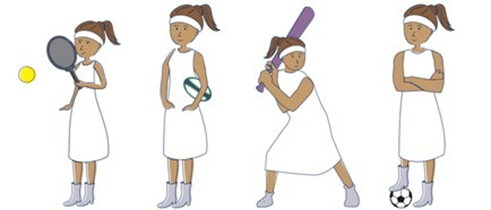
Figures 2a, 2b, 2c, 2d
If filing figures 3a, 3b and 3c (below) as three separate views, the application is likely to be considered unacceptable as although each view has similarities and they are linked in that a user may move from one screen to the next, the overall impression is not of a single unitary design. The figures show different screens which will vary depending on user input, hence the examiner would likely consider that the figures show three different and distinct GUIs. Applicants should therefore consider seeking protection for this type of design as separate applications either at the application stage or by dividing an application in response to an objection.
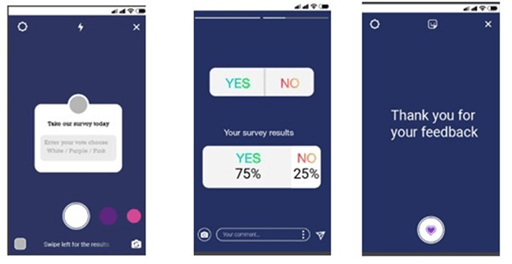
Figures 3a, 3b, 3c
If filing figures 4a and 4b (below) as two separate representations, the application is likely to be considered acceptable if the Applicant has indicated that the design is a GUI with a pop up. The Applicant could also include a disclaimer explaining the transition to ensure that the nature of the transition is clear to anyone viewing the register. If protection is sought for a more complicated arrangement of pop ups, an examiner will consider whether the visual appearance changes such that the representations are not considered to relate to a single design.
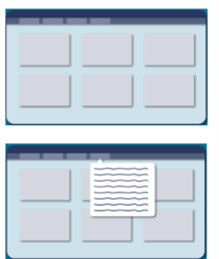
Figure 4a, 4b
For more articles on best practice for registered designs, or to contact one of our experts, visit our designs page.