Disclaimer: our trainee blogs are written by trainees for trainees, offering career insights and industry perspectives.
What is a supplementary protection certificate (SPC)?
A patent grants the proprietor the exclusive right to make, sell, offer to sell, use, keep or import their product. However, pharmaceutical and plant protection products require extensive testing and regulatory approval prior to being placed on the market in many jurisdictions, including the UK and Europe. The delay, resulting from obtaining such authorisation, reduces the period during which the proprietor can exclusively exploit their invention – this period is often referred to as the ‘effective patent term’.
A supplementary protection certificate (SPC) compensates for the loss of effective patent term. It extends the protection conferred by the patent in respect of the product covered by the medicinal or plant protection authorisation – it does not extend the term of the patent itself!
Given the huge commercial value of these pharmaceutical and plant protection products, and the competitive marketplace, the extension provided by an SPC can be extremely lucrative for the proprietor as they can continue to hold the monopoly over their product and take action to prevent generics reaching the market.
What is the term of an SPC?
The protection takes effect once the patent has expired.
In the UK and Europe, the term of SPC protection is equal to the period between the date the patent application was filed, and the date of product authorisation, minus five years. However, the term cannot exceed five years in total. This is shown in more detail in the following examples, where there are 8 and 12 years between the date on which the application is filed and the date of the product authorisation, respectively.
8 years
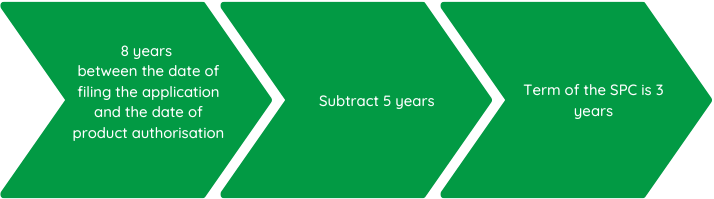
12 years

What are the requirements for an SPC?
An SPC will be issued if:
- the product is protected by a basic patent in force,
- a valid authorisation to place the product on the market as a medicinal product or plant protection product has been granted,
- the product has not already been the subject of a certificate, and
- the authorisation is the first authorisation to place the product on the market as a medicinal product.
Under SPC regulations, the term ‘product’ refers to the active ingredient or a combination of active ingredients. Excipients and carriers in a pharmaceutical product that do not have a therapeutic effect would not qualify for SPC protection.
The marketing authorisation must cover the product claimed in the patent. It is possible to protect a combination of therapies however, recent case law suggests that, at least in the UK, the marketing authorisation must cover this combination.
For example, if a patent claims a monoclonal antibody in combination with a chemotherapy drug, then the marketing authorisation should cover this combination of products. A marketing authorisation covering only one of these products is unlikely to be sufficient to obtain an SPC for a combination therapy in the UK.
Where are SPCs available?
SPCs can be obtained in the UK, EU member states and Switzerland, Norway and Iceland. Some countries also provide a patent term extension for medicinal products, these include Japan, Canada and the US.
How do you apply for an SPC?
An SPC is a national right – there is no centralised SPC currently! Therefore, to obtain an SPC, you must apply directly at the national office.
The application for an SPC must be filed:
- within 6 months from the date on which the market authorisation for the medicinal product was granted or
- within 6 months from the date on which the patent is granted if the patent was not granted when the market authorisation was granted.