
Three-dimensional (3D) printing, also known as additive manufacturing, has revolutionised various product development and manufacturing processes over the past decade or so. A 3D printer can be used to produce different 3D objects from a digital file by gradually layering material from one or more print heads. This is in contrast to subtractive computer-aided manufacturing methods such as machining, drilling and etching, which tend to be more costly and create greater amounts of waste. 3D printing is also unlike traditional manufacturing methods for which specialised tools or moulds (themselves often manufactured by machining) may be required to produce a single product specification. Instead, a single 3D printer may be used to build different products. As a result, prototypes, individualised products, and short series designs can be made more economically without the high investments associated with traditional manufacturing techniques.
Global filing trend
The first patent describing a 3D printer (US3596285A) was filed in 1969. The first commercially successful 3D printer, the SLA-1, however arrived in 1986 and was the subject of another patent (US4575330A). Since then, 3D printers have been developed further and have even made their way into some private households. It is estimated that the global market for additive manufacturing will experience an annual growth rate of 23.3% until 2030[1].
The number of patent filings directed towards 3D printing apparatus, methods or software began to increase exponentially around 2010. By 2017, the number of annual patent filings was 140x greater than it was in 2010. Since then, the rate of patent filings has slowed down, although the number of patent filings per year remains relatively high.
Figure 1: Ten-year trend (2013-2022) – global priority filings – 3D printing
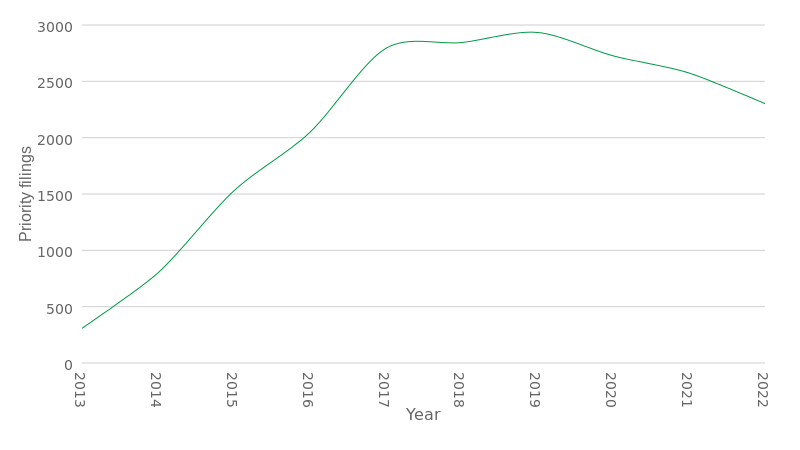
The main factor influencing the sudden increase in innovation in 3D printing is the expiration of key patents filed in the 1980s. For example, the long-awaited expiry of the patent describing fused deposition modelling (US5121329A) filed in1989, represented a breakthrough for those wishing to experiment with 3D printing technology. With the expiry of such patents, the prices of 3D printers began to dramatically drop, and knowledge sharing around 3D printing was arguably “democratised”[1] thanks to the internet. Innovation has also been helped by developments in material science, allowing 3D printing to be used in new, versatile ways.
The gradual fall in the number of annual filings suggests that 3D printing technology has finally matured, and that few problems remain to be addressed by new inventions. Alternatively, it may be that a temporary bubble around the use of 3D printing for consumer products has burst but that the technology will continue to mature for industrial (rather than consumer) purposes.
Patent filings by territory
Figure 2: Ten-year trend (2013-2022) – Priority filings by territory – 3D printing
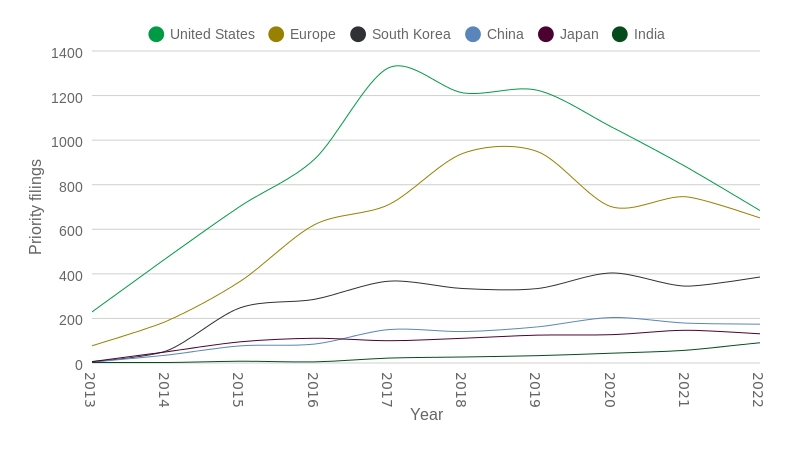
Most patent applications towards 3D printing are filed in the USA, followed by Europe. This could be due to the temporary consumer hype surrounding 3D printing in the 2010s which did not spread much further outside of the US and Europe.[3]
Whilst filings from the USA and Europe are decreasing, filings from South Korea, China, and India, are on the rise. It is expected that filings for 3D printers in the Asian market will grow significantly in the coming years[2] due to related growth in various manufacturing sectors. The various government drives to integrate 3D printing into important industries in these countries are an important factor in the projected growth[3]. For example, in 2014, the South Korean government established a 3D printing roadmap to support research and development. In China, the ‘Additive Manufacturing Industry Development Action Plan’ was issued by the government in 2017.[4] A survey by EY in 2016, indicated that 24% of South Korean and Chinese companies were familiar with 3D printing. By 2019, this percentage had risen to 81% and 78% respectively.[5] Although innovation in 3D printing worldwide may be slowing overall, the number of patent filings from Asian countries is likely to continue increasing.
Key players
Figure 3: Ten-year trend (2013-2022) – top filers – 3D printing
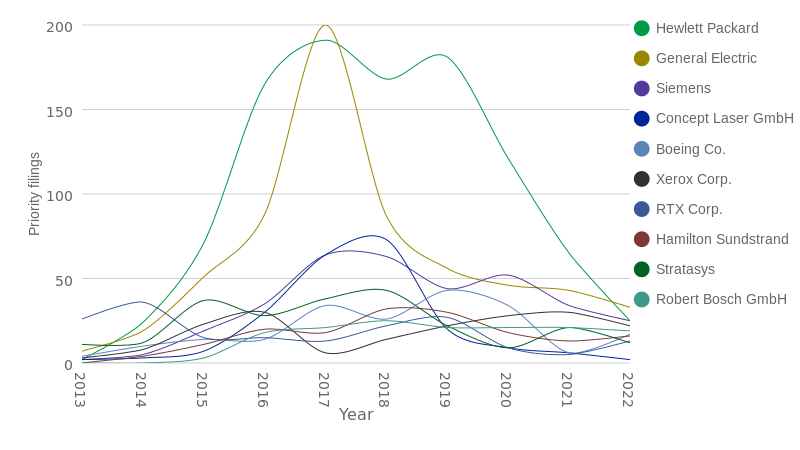
By far the greatest number of recent priority filings in 3D printing has come from Hewlett Packard Development Co., an American company that offers off-the-shelf 3D printers. Filings from Hewlett Packard peaked in 2019 and have dropped since, indicating that 3D printing technology for general purposes is maturing.
American organisation, General Electric, is also a major player, with filings that mainly relate to methods and apparatus for additive manufacturing using metallic powders and ceramics, as well as welding or soldering. Many filings by General Electric also appear in the IPC subclasses (indicating the subject matter of the filings) for engines, turbines, and heat exchangers. As the annual number of filings from General Electric (as well as from Boeing, RTX, Hamilton Sundstrand, Safran, BMW and Volkswagen Group) are now falling, 3D printing technologies used for manufacturing aerospace and automotive parts may also be maturing.
On the other hand, top filers which show a clear increase in patent filings in recent years (albeit in more modest numbers) include Renishaw PLC, Covidien, and Align Technology, who make 3D printed medical and/or dental devices for use in implants. The focus of innovation in 3D printing could therefore be shifting from consumer products and aerospace/automotive components towards medical technologies.
By far the greatest number of recent priority filings in 3D printing has come from Hewlett Packard Development Co., an American company that offers off-the-shelf 3D printers. Filings from Hewlett Packard peaked in 2019 and have dropped since, indicating that 3D printing technology for general purposes is maturing.
American organisation, General Electric, is also a major player, with filings that mainly relate to methods and apparatus for additive manufacturing using metallic powders and ceramics, as well as welding or soldering. Many filings by General Electric also appear in the IPC subclasses (indicating the subject matter of the filings) for engines, turbines, and heat exchangers. As the annual number of filings from General Electric (as well as from Boeing, RTX, Hamilton Sundstrand, Safran, BMW and Volkswagen Group) are now falling, 3D printing technologies used for manufacturing aerospace and automotive parts may also be maturing.
On the other hand, top filers which show a clear increase in patent filings in recent years (albeit in more modest numbers) include Renishaw PLC, Covidien, and Align Technology, who make 3D printed medical and/or dental devices for use in implants. The focus of innovation in 3D printing could therefore be shifting from consumer products and aerospace/automotive components towards medical technologies.
Emerging technical applications
One way to investigate the more specific areas of technology in which innovation related to 3D printing is occurring is to analyse the literature cited in the prosecution of patent applications. The published prior art which has been cited in recent years (i.e. considered relevant by the responsible patent offices) reveals the existing technology that new patent applications are building on in order to bring new ideas to the market.
The following graph shows the number of citations by patentee (of the prior art) each year since 2013.
Figure 4: Ten-year trend (2013-2022) most commonly cited patentees during patent prosecution – 3D printing
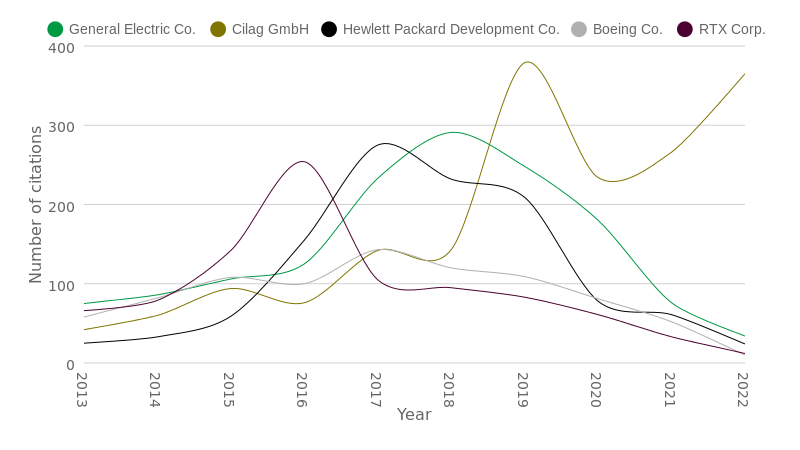
Figure 4 demonstrates that different patentees (and therefore different subject matters) became very relevant to new inventions for short periods of time before dropping in relevance.
Publications from aerospace and engine manufacturers formed most of the prior art in the years between 2016 – 2019, suggesting that in these years, 3D printers and 3D printing methods were being developed for aircraft and vehicles. From 2019 onwards, by far the most frequently cited patentee was Cilag GmbH, a Swiss company specialising in pharmaceuticals and medical technology. Medical industries could therefore be the next biggest beneficiary of innovation in 3D printing.
3D printing can be used not only to produce medical tools or implants but also to generate biological tissue-like structures that are used in medical and tissue engineering fields. Analogous to conventional 3D printing, bioprinting uses a layer-by-layer method to deposit material into a pre-defined 3D structure. However, instead of using traditional materials such as polymer melts or metallic powders, bioprinting uses “bio-ink” comprising living cells, biomaterials, or active molecules to produce 3D biological structures. This technology is still in its infancy, so bioprinting trends do not appear in the above general searches, but is explored in greater detail in our bioprinting article.
Final remarks
While the consumer hype around 3D printing was short-lived in the Western world, there remains a demand for improved technology for manufacturing, prototyping and customisation. The continued growth in innovation related to 3D printing in Asia, where this technology was seen mainly as a commercial, rather than consumer, tool, shows that innovation in this field continues to be relevant in some industries. The appearance of medical and dental technology manufacturers among top filers and the shift in the type of literature being cited by patent offices around the world indicates that, while the overall number of patent filings per year has fallen, innovation in 3D printing in specific areas such as medicine, is still taking off.
This technology is still in its infancy, so bioprinting trends do not appear in the above general searches, but are explored in greater detail in our bioprinting article.
Due to an 18-month lag between priority filing (first patent filing) and publication, data for 2023 and 2024 has not been reported.