
With Tadej Pogačar having won his fifth Tour de France this July, which also marked his sixth Grand Tour victory, the landscape of men’s professional cycling currently feels very predictable. Similarly, women’s cycling is increasingly dominated by a small group of riders, including Demi Vollering and Lotte Kopecky.
The names at the front of the peloton don’t seem to be changing, but patent trends suggest that innovation in the cycling world is.
Historically, cycling patents have related to mechanical advances: lighter frames, more aero wheels, or improved suspension systems. However, a review of patent publications related to cycling over the last 20 years shows that the proportion of inventions relating to software, electronics, communications, and control systems is increasing.
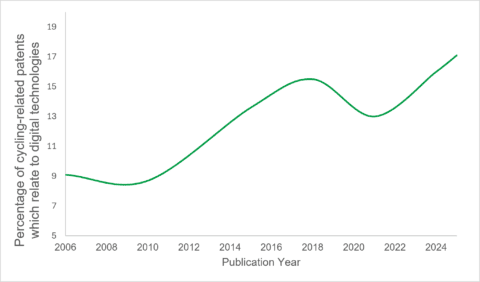
The accompanying graph was generated using CPC codes. Bicycle-related patent publications were first identified using the following CPC codes:
• B62K – Cycles; cycle frames; steering devices
• B62M – Driving arrangements for cycles
• B62J – Cycle accessories and equipment
• B62H – Cycle stands, supports, or holders for parking or storing cycles
A second dataset was then created by identifying patents that fell within those cycling classifications and additionally referred to the following keywords:
• Electronic
• Sensor
• GPS
• Bluetooth
• Wireless
• Firmware
• Computer
• Navigation
The results show that digital cycling patents have grown faster than total cycling patents, with the percentage of cycling-related patents published that relate to digital technologies increasing from around 9% in 2006 to around 17% in 2025. This suggests that digital technology in the bike industry is becoming increasingly significant.
This methodology isn’t perfect, but it does indicate a change in the landscape within cycling innovation.
The growth appears to be driven by several areas of technology: Internet of Things, connectivity and app integration; battery management and smart charging; GPS, navigation and cycling computers; electric-drive control software; and radar/proximity safety systems.
The graph below shows the number of patents published in 2006 vs. 2024 for each area of technology.
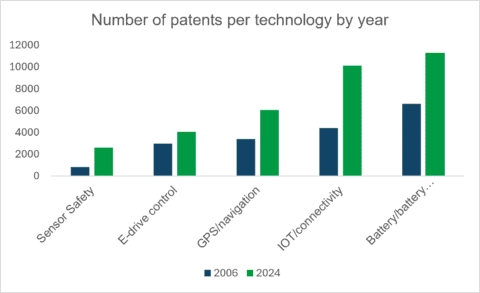
The growth in these areas has not been uniform. The following graph shows the absolute increase in published patents from 2006 to 2024.
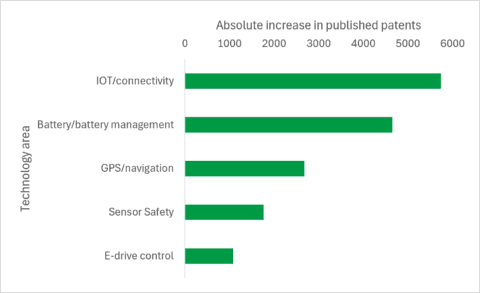
By these numbers, IoT, connectivity and app integration; and battery management and smart charging seem to be large contributors to patent growth and account for about 65% of the total increase between 2006 and 2024.
Examples of where this innovation lies can be seen in the following patents and patent applications:
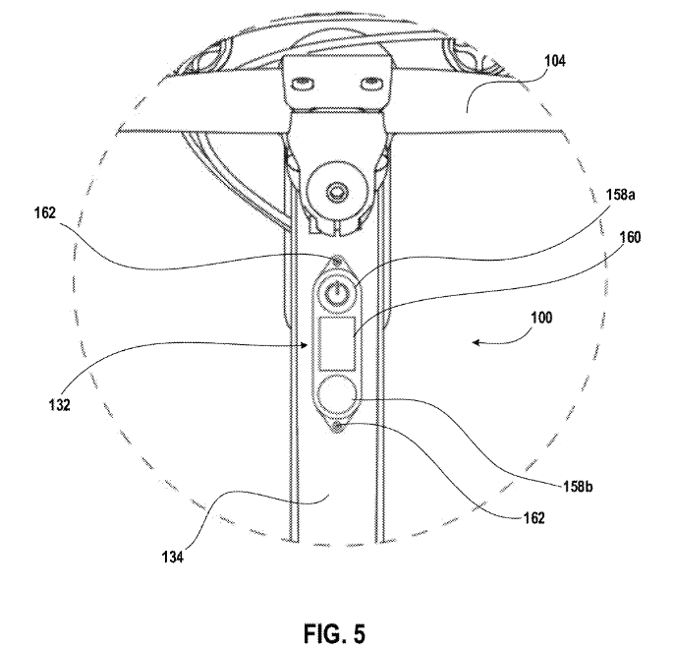
US patent US12246795B2, from SRAM is an example that falls into the IoT, connectivity and app integration category. The patent relates to a frame-mounted human-machine interface (132) for an electric bicycle. The interface allows rider inputs to be wirelessly transmitted to the bike’s control system, which can then relay the input to the relevant component. Inputs may include turning part of the e-bike system (for example, the assist motor) on or off, or displaying characteristics of the e-bike system such as battery power, gear indication, power level, speed, or cadence.
US11794854B2 is an example of a Honda patent that relates to e-drive control. It describes an e-bike assist system that can estimate rider pedal force without using a dedicated torque sensor or strain gauge. Rider effort is instead determined using measurements already available within the system.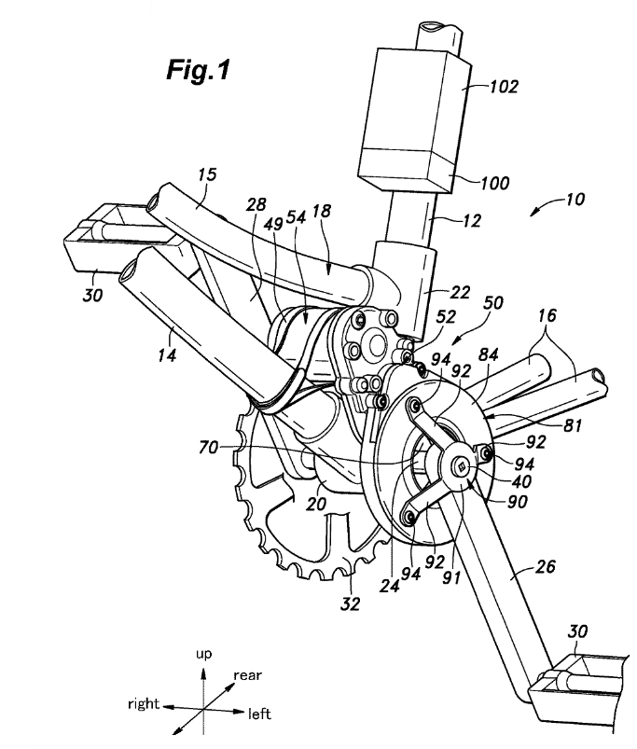
Garmin’s patent US10527722B2 relates to a sensor safety system. It describes the use of sensors such as RADAR to detect obstacles. The user is then alerted of upcoming obstacles such as moving vehicles, pedestrians, or other cyclists.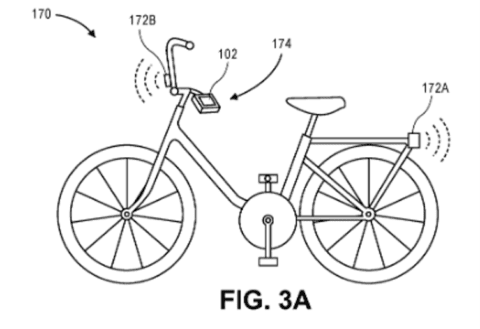
Looking ahead, we might expect this increase in digital technologies to extend to more innovation featuring AI. There has already been some movement in this field:
Shimano’s granted patent, US2025319943, relates to an e-bike drivetrain that is controlled to change gear automatically when the rider is not pedalling. The system determines when gear shifts should take place by considering sensor information about the rider, the bike, and the surrounding environment from sensors including a speed sensor, a crank rotation sensor, a human driving force sensor, GPS, and LiDAR. An embodiment of this invention uses AI techniques to predict the conditions ahead of the rider and to determine when a gear shift should happen.
Strava provides recommended routes using generative models in patent application US20260177393. The application describes a diffusion machine learning model that has been trained using historical athlete activities to generate new routes that are more in line with routes that would be chosen by real cyclists.
The patent data suggests that whilst mechanical inventions are still important, digital patents are becoming increasingly central to future development. With the rise of AI, and improvements in battery technology, this is likely to continue.
As digital technologies continue to reshape the cycling industry, robust IP protection will be essential for companies looking to safeguard their innovations, whether in AI-driven route generation, e-drive control systems, or connected safety features. If you are developing technology in this space and want to discuss how to protect your innovations, please get in touch with our patent team.